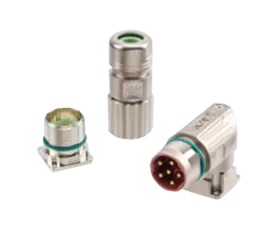
In modern industrial and communication systems, te rf connectors are no longer simple interconnection components. They are precision RF transmission elements that directly determine signal integrity, system stability, and electromagnetic performance in high-frequency environments such as wind power monitoring, high-speed rail communication, automotive radar, and industrial automation networks.
Unlike general-purpose connectors, RF connectors must maintain controlled impedance, low insertion loss, and stable shielding effectiveness under vibration, temperature cycling, and long-term mechanical stress. This makes their design and selection a multidisciplinary engineering challenge involving electromagnetics, materials science, and mechanical reliability.
This article provides a technical breakdown of te rf connectors, focusing on impedance control, frequency behavior, material selection, interface design, and application-driven performance requirements.

1. Electrical Performance: Why Impedance Control Defines RF Connector Quality
The core function of te rf connectors is to maintain a stable transmission path for high-frequency signals, typically in the range of MHz to GHz.
Characteristic Impedance Matching
Most RF systems are designed around standard impedance values:
- 50Ω (most communication, industrial RF systems)
- 75Ω (video, broadcast applications)
A deviation of more than ±5Ω can cause:
- Signal reflection (VSWR increase)
- Power loss
- Data error in high-speed transmission
High-quality te rf connectors maintain impedance tolerance within:
- ±0.5Ω to ±1Ω under controlled manufacturing conditions
Key Electrical Metrics
- Insertion Loss: typically <0.1 dB at 1 GHz
- Return Loss: >20 dB for high-performance connectors
- VSWR: <1.2:1 in optimized designs
- Shielding Effectiveness: >85–100 dB depending on structure
These parameters directly influence signal integrity in systems such as radar, industrial IoT gateways, and railway communication modules.
2. Frequency Performance: Behavior Under GHz-Level Operation
As systems move toward higher bandwidth requirements, te rf connectors must support stable performance across wide frequency ranges.
Typical operating bands:
- Sub-6 GHz (industrial communication, LTE systems)
- 6–18 GHz (radar, high-speed data links)
- 18–40 GHz (advanced aerospace and testing systems)
At higher frequencies, even minor structural imperfections can introduce:
- Signal attenuation
- Phase distortion
- Mode conversion (TEM to higher-order modes)
Skin Effect and Conductor Loss
At GHz frequencies, current flows primarily on the conductor surface. This means:
- Surface roughness directly impacts loss
- Gold plating or silver plating reduces resistive loss
- Micro-scale machining quality becomes critical
A 1 μm increase in surface roughness can lead to measurable insertion loss increase at high frequencies.
3. Mechanical Design: Ensuring Stability Under Vibration and Shock
Industrial applications such as wind turbines, rail transit systems, and automotive platforms expose connectors to continuous mechanical stress.
Key Mechanical Requirements
- Mating cycle life: typically 500–5000 cycles
- Vibration resistance: up to 10–2000 Hz depending on standard
- Shock resistance: 50–500 g mechanical shock tolerance
- Torque stability: consistent coupling force over repeated assembly
Threaded interfaces (e.g., SMA, TNC-style structures) are commonly used in te rf connectors to ensure:
- Stable contact pressure
- High resistance to loosening under vibration
- Improved shielding continuity
Snap-on interfaces offer faster assembly but are less suitable for high-vibration environments.
4. Material Selection: Conductivity, Durability, and Corrosion Resistance
Material engineering plays a critical role in RF performance and lifecycle reliability.
Common Materials in te rf connectors
1. Brass (CuZn alloy)
- Good machinability
- Cost-effective
- Suitable for general RF applications
2. Phosphor Bronze
- Higher elasticity
- Better contact reliability under repeated mating
3. Stainless Steel (304/316)
- High mechanical strength
- Excellent corrosion resistance
- Used in harsh environments
Plating Systems
- Gold plating (0.5–2 μm):
- Lowest contact resistance
- Best for high-frequency signal stability
- Nickel underlayer:
- Improves adhesion and corrosion resistance
- Silver plating:
- Lower resistive loss but prone to oxidation
Material selection is always a trade-off between conductivity, mechanical strength, and environmental resistance.
5. Shielding Effectiveness: Controlling EMI in High-Density Systems
Electromagnetic interference (EMI) is a major issue in modern industrial environments.
te rf connectors must provide continuous shielding from cable to interface to prevent:
- Crosstalk between adjacent channels
- External noise coupling
- Signal degradation in high-density layouts
Shielding Mechanisms
- 360° metal-to-metal contact
- Precision machined outer conductor surfaces
- Controlled gap tolerance (<0.05 mm in high-end designs)
High-performance connectors achieve:
- Shielding effectiveness: 90–120 dB depending on frequency
This is critical in environments such as:
- Railway signaling systems
- Wind turbine control networks
- Industrial automation PLC networks
6. Environmental Reliability: Temperature, Humidity, and Corrosion
Industrial-grade te rf connectors must operate under extreme environmental conditions.
Operating Conditions
- Temperature range: -55°C to +125°C
- Humidity: up to 95–98% RH
- Salt spray resistance: 48–720 hours depending on specification
- Protection rating: IP65–IP68 in sealed designs
Failure Mechanisms
- Oxidation of contact surfaces
- Dielectric breakdown under humidity
- Mechanical loosening under thermal cycling
High-quality designs mitigate these risks through:
- Multi-layer sealing systems
- O-ring or gasket integration
- Anti-corrosion plating systems
7. Manufacturing Precision: Why Micron-Level Control Matters
RF connectors operate at frequencies where geometry deviations directly impact electrical performance.
Key manufacturing tolerances:
- Center conductor alignment: ±0.01 mm
- Impedance-critical dimensions: ±0.02 mm
- Surface roughness: Ra ≤ 0.4 μm for high-frequency models
Production Processes
- CNC precision turning for contact pins
- Cold forming for outer shells
- Automated plating lines for consistent coating thickness
- 100% electrical testing for critical batches
Even small deviations can lead to:
- Impedance mismatch
- Increased insertion loss
- Reduced connector lifespan
8. Testing and Validation: Ensuring Compliance with IEC and UL Standards
te rf connectors must comply with global standards to ensure interoperability and safety.
Relevant standards include:
- IEC 61169 (RF connector specifications)
- UL electrical safety standards
- GB/T connector performance requirements
Key Test Categories
- S-parameter measurement (VNA testing)
- Mating durability cycles
- Vibration and shock testing
- Thermal cycling (-55°C to +125°C)
- Salt spray corrosion testing
Only connectors passing full validation can be used in critical infrastructure systems.
9. Application Scenarios: Industrial Systems Driving RF Connector Demand
Wind Power Systems
- Long-distance signal transmission
- High vibration and outdoor exposure
- Requires corrosion-resistant and vibration-proof designs
High-Speed Rail
- Signal stability under continuous movement
- EMI-heavy environment
- High shielding effectiveness required
Automotive Systems
- Radar (24 GHz / 77 GHz)
- ADAS modules
- Compact, high-frequency connectors with low loss
Industrial Automation
- High-density signal distribution
- Reliable long-cycle operation
- Modular connectivity systems
Conclusion: te rf connectors as Precision RF Infrastructure Components
te rf connectors are not passive components—they are precision-engineered RF transmission interfaces that directly determine system performance in high-frequency and high-reliability environments.
Optimizing their performance requires control over:
- Impedance consistency and RF behavior
- Material conductivity and plating systems
- Mechanical stability under vibration
- Environmental resistance and sealing
- Manufacturing precision at micron-level tolerance
In modern industrial systems, where data integrity and signal stability are critical, the performance ceiling of the entire system is often defined by the RF connector itself.