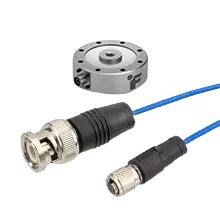
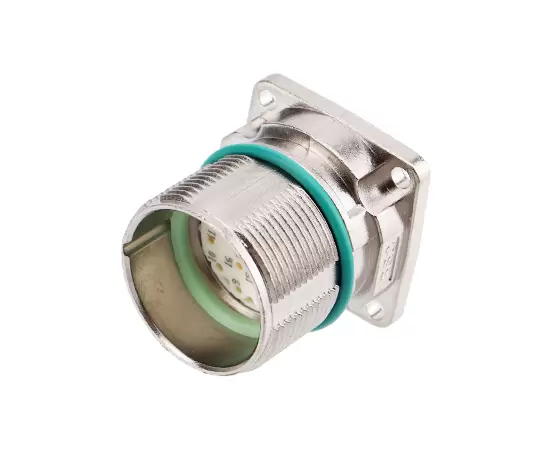
Industrial robots have extremely strict requirements for connectors. They must maintain stable and reliable power, signal, and data transmission under harsh conditions such as continuous vibration, mechanical shock, dust, and oil contamination. Therefore, connectors used in industrial robots typically feature high protection ratings, vibration resistance, compact design, and high integration capabilities.
Depending on their position and function within a robotic system, industrial robot connectors can mainly be divided into the following categories:

External Connections: Circular Connectors
Circular connectors are the core components for external connections in industrial robots. They are mainly used to connect the robot body with the control cabinet, as well as connect end-of-arm sensors, actuators, and other devices. They are widely recognized for their robust design and excellent protection performance.
M12 Connectors
Features:With a nominal thread diameter of 12 mm, M12 connectors are one of the most widely used connector solutions in industrial automation. They feature a compact and rugged structure and commonly provide high protection ratings such as IP67/IP68, effectively preventing dust and water ingress.
Through different physical coding systems such as A-coded, B-coded, D-coded, and X-coded versions, M12 connectors can prevent incorrect insertion between devices with different functions.
Applications:M12 connectors are widely used for connecting sensors, actuators, and I/O modules. They support data transmission ranging from low-speed signals to high-speed 10Gbps Ethernet communication.
For example, A-coded M12 connectors are commonly used for sensors and 1Gbps Ethernet applications, D-coded versions are designed for 100Mbps Ethernet, while X-coded M12 connectors are specifically developed for 10Gbps high-speed industrial Ethernet transmission.
M23/M40 Series Connectors
Features:Compared with M12 connectors, M23 and M40 series connectors have larger dimensions and can handle higher power and current levels, with some models supporting up to 150A/630V transmission while also allowing signal transmission.
Some versions adopt quick-locking technologies such as ONECLICK or SPEEDCON, enabling fast and secure connections without additional tools while providing clear locking feedback.
Applications:These connectors are mainly used for supplying reliable power to high-power components such as robot joints, drive systems, and servo motors while transmitting control signals.
Heavy-Duty Connectors (Such as Han Q Hybrid)
Features:Heavy-duty connectors usually adopt rectangular housings. Their biggest advantage is hybrid integration capability.
A single connector can integrate power contacts, signal contacts, and industrial network interfaces such as EtherCAT, significantly simplifying wiring and saving installation space.
Applications:They are particularly suitable for collaborative robots and complex equipment requiring strict space and weight optimization. One compact interface can meet multiple connection requirements simultaneously.
Internal Connections: Board-to-Board Connectors and Flexible Circuits
Inside the robot body, such as robotic joints and control cabinet PCBs, connectors must handle challenges caused by limited installation space and continuous mechanical movement.
Floating Board-to-Board Connectors
Features:Floating board-to-board connectors allow small relative movement in the X, Y, and Z directions.
This floating capability effectively compensates for assembly alignment errors and absorbs vibration and shock generated during operation, protecting solder joints and contacts while extending service life.
Applications:They are widely used for high-density PCB connections inside robot joints and servo system module connections, ensuring stable signal transmission during dynamic movement.
Flexible Printed Circuit (FPC)
Features:FPCs offer excellent flexibility and can be bent or folded, making them highly suitable for wiring in compact spaces with constantly changing movement conditions.
Applications:They are an ideal connection solution inside robotic arm joints, where repeated bending and movement are common.
Data Transmission: Industrial Ethernet Connectors
With the development of Industry 4.0, industrial robots need to process and transmit increasing amounts of data. This has created higher requirements for connector transmission speed and reliability.
Single Pair Ethernet (SPE)
Features:SPE technology uses only one twisted pair to simultaneously transmit data and power, greatly simplifying wiring while reducing system cost and weight.
Applications:It is suitable for connecting large numbers of distributed sensors and actuators, especially in space-limited environments, providing an efficient connection solution for Industrial Internet of Things (IIoT) applications.
Main Types of Industrial Robot Connectors
| Connector Type | Main Features | Typical Applications |
|---|
| Circular Connectors (M12/M23, etc.) | High protection rating (IP67/IP68), rugged design, vibration resistance | External robot connections, sensors, actuators, servo motors |
| Heavy-Duty Connectors (Han Q Hybrid) | Hybrid integration (power + signal + network), space-saving design | Collaborative robots and complex equipment requiring simplified wiring |
| Floating Board-to-Board Connectors | Three-axis floating capability, absorbs assembly errors and vibration | Robot joints and control cabinet PCB connections |
| Flexible Printed Circuit (FPC) | Highly flexible and bendable | Dynamic bending areas such as robotic arm joints |
| Single Pair Ethernet (SPE) | One cable for data and power transmission, simplified wiring | Distributed sensor and actuator networks |
Core Technical Features of Robot Connectors
High Mating Cycles:Industrial environments require connectors to withstand tens of thousands of mating cycles.For example, some circular connectors from leading manufacturers can achieve up to 50,000 mating cycles, ensuring long-term reliability in frequently maintained robotic systems.
Vibration Resistance:Industrial robot connectors typically use threaded locking mechanisms and spring contact structures to maintain stable connections during continuous robotic movement and vibration.
Protection Rating:Industrial robot connectors generally need to meet IP67/IP68 protection standards to ensure resistance against dust and water in harsh working environments.
Current Carrying Capability:Power connectors must support high current transmission requirements. Many industrial robot power connectors need to handle currents ranging from 10A to 100A. For example, some high-power connector series can support up to 100A current transmission.
Transmission Speed:High-speed data connectors used in modern robots support transmission rates of 10Gbps or higher to meet the requirements of industrial Ethernet and real-time control systems.
Five Key Factors for Selecting Robot Connectors
Electrical Parameters:Connector selection should be based on motor power requirements, including operating voltage and current levels. Common industrial robot systems use 24V, 48V, or 400V power architectures.
Signal Integration Level:Hybrid connectors are often preferred because they can simultaneously transmit power, Ethernet communication, and I/O signals, reducing wiring complexity.
Space Limitations:Collaborative robots usually require smaller connectors, with some applications adopting ultra-miniature connectors with diameters below 5mm.
Environmental AdaptabilityOutdoor robots and harsh industrial applications require connector materials capable of withstanding extreme temperatures, typically ranging from -40°C to +125°C.
Maintenance Cost:Modular quick-connect designs can reduce equipment downtime and improve maintenance efficiency. For example, CAZN’s M12 coded connectors provide reliable and efficient connection solutions for industrial automation applications.

Conclusion
The selection of connectors for industrial robots is ultimately about balancing reliability, performance, and space efficiency.
Modern robot connectors have evolved from simple electrical interfaces into critical intelligent components that ensure stable operation, reliable signal transmission, and efficient data communication in demanding industrial environments.
With the continuous development of smart manufacturing and Industry 4.0, high-performance connectors such as M12 connectors, hybrid connectors, and industrial Ethernet solutions will continue to play an essential role in improving the reliability and flexibility of robotic systems.