Jul 02, 2025
A Complete Guide to Connector Socket Types and Their Functions

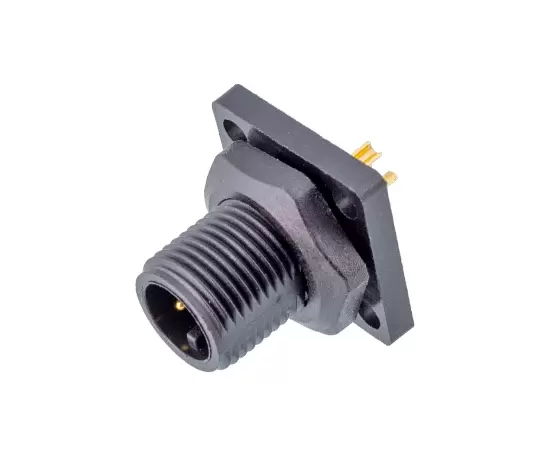
The M8 connector is a miniature industrial circular connector designed according to the IEC 61076-2-104 international standard. Developed for industrial automation applications where installation space is limited and distributed signal acquisition is required, M8 connectors are widely used with remote I/O modules, compact sensors, and small actuators.
The M8×1.0 thread provides a compact form factor suitable for confined installation spaces and high-density remote I/O ports.
Straight and right-angle versions are available, with keying features to prevent incorrect insertion and threaded locking to improve vibration resistance and prevent loosening.
M8 connectors typically support a rated voltage of 50V AC / 60V DC and a maximum current of 3A, making them suitable for 24V industrial sensor power supply and signal transmission.
Gold-plated contacts provide low contact resistance and reduced signal loss, while the mating cycle life can reach ≥500 cycles.
Pin configurations include 2-, 3-, 4-, 5-, and 8-pin versions, with A, B, and D coding available for different sensor, fieldbus, and Ethernet applications.
The standard protection level is typically IP67, providing protection against dust, water ingress, oil contamination, and condensation.
The connectors are designed to withstand vibration and mechanical shock, making them suitable for dynamic operating environments such as production lines and robotic systems.
Housing materials include nickel-plated brass and engineering plastics, providing resistance to corrosion and mechanical wear.
Cable jackets can be selected from PVC, PUR, and halogen-free flame-retardant materials according to the application.
PUR cables provide superior flexibility and resistance to repeated bending and dragging, making them particularly suitable for moving equipment and dynamic cable-routing applications.
Threaded quick connection simplifies field installation without complicated soldering or stripping operations.
The independent plug-and-play design allows individual connection points to be replaced when faults occur without modifying the complete wiring system.
Based on international standards, M8 connectors can be widely integrated with remote I/O systems, proximity switches, photoelectric sensors, and other industrial automation devices across different brands.

| Comparison | M8 Connector | M12 Connector |
|---|---|---|
| Thread specification | M8×1.0 | M12×1.0 |
| Typical pin count | 2–8 pins | 3–12 pins |
| Rated current | Up to 3A | 4A–8A, depending on specification |
| Rated voltage | 50V AC / 60V DC | Up to 250V AC |
| Protection level | IP67 | IP67 |
| Form factor | Compact, suitable for confined spaces | Larger overall size |
| Coding types | A/B/D/P coding | A/B/C/D/X coding; X coding supports Gigabit Ethernet |
| Main applications | Field sensors, actuators, remote I/O signal ports, proximity switches, photoelectric sensors | Main buses, EtherCAT/PROFINET, high-current equipment, module power supply |
| Typical applications | Robot joints, compact remote I/O, high-density workstations | Control cabinets, bus trunk cables, equipment power supply |
| Cable characteristics | Smaller-diameter cables, short-distance signal routing | Larger cable sizes and longer-distance bus transmission |
| Standard | IEC 61076-2-104 | IEC 61076-2-101 |
Selecting M8 connectors for IO-Link applications requires consideration of three key dimensions: protocol characteristics, hardware specifications, and operating conditions. The connector, cable, I/O module, and master station should be considered as one complete connection system.
For IO-Link applications, an M8 A-coded connector should be selected to comply with the relevant IEC 61076-2-104 requirements.
A 4-pin configuration is required for standard IO-Link device connectivity. The typical pin assignment is:
Pin 1: 24V+ power supply
Pin 3: 0V
Pin 4: C/Q bidirectional communication channel
Pin 2: Auxiliary I/O or unused, depending on the device configuration
A 3-pin M8 connector cannot provide the complete standard IO-Link connection required for power and bidirectional communication.
For electrical compatibility, the connector should support at least 60V DC and 3A, with contact resistance of ≤10 mΩ, providing sufficient margin for 24V IO-Link sensors and their communication requirements.

For field-customized wiring, a solderless screw-terminal or screw-clamp version can be preferred. It does not require specialized crimping equipment and allows cables to be cut and terminated directly at the installation site, making it suitable for logistics sorting systems and automotive welding lines.
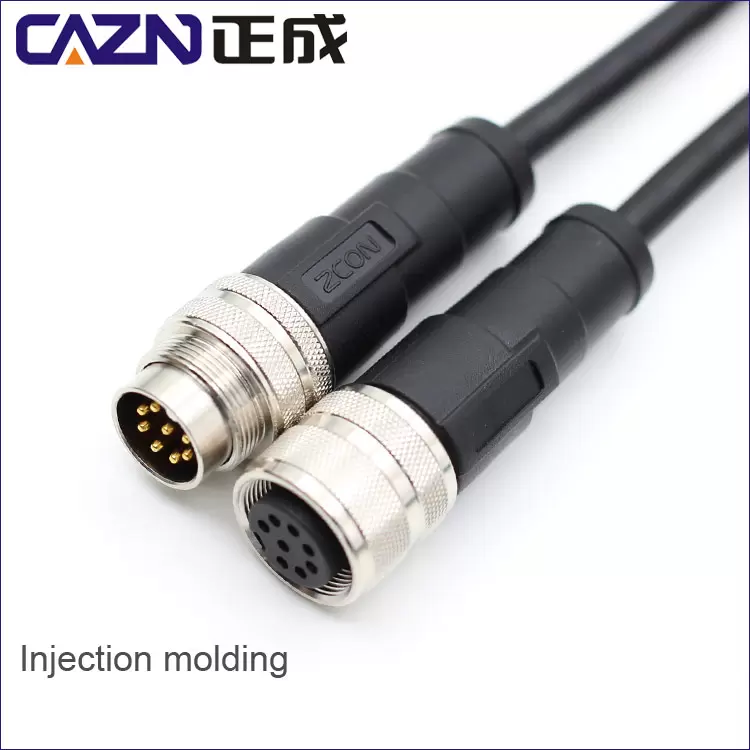
For standardized high-volume production wiring, pre-molded injection-molded cable assemblies are generally preferable because the integrated construction provides more consistent sealing performance and simplifies large-scale cable preparation.
Connector geometry should also match the available installation space.
For applications with sufficient clearance and straightforward cable routing, a straight M8 connector provides simple installation and convenient mating access.
For densely installed sensors or confined spaces, a 90° right-angle M8 connector can reduce installation depth and help prevent excessive cable bending.
For standard industrial applications, an M8 connector with an IP67 mating protection rating is generally appropriate.
For automotive welding lines and other environments exposed to oil, welding spatter, vibration, and temperature fluctuations, a PUR-jacket cable combined with a stainless-steel M8 connector provides improved resistance to oil, mechanical stress, and environmental exposure.
For demanding applications, a working temperature range of approximately -40°C to +80°C can provide a suitable operating window for outdoor equipment, automotive production lines, and other temperature-variable environments.

Connector selection should not be considered independently from the IO-Link master or distributed I/O module.
If a distributed I/O module uses M12 A-coded ports, such as certain IP67 distributed I/O systems, an M8 connector cannot be directly connected. An M8-to-M12 adapter cable is required to complete the signal transition.
For compact IP20 I/O modules installed inside control cabinets and equipped with M8 ports, M8 connectors can be connected directly. Since the cabinet environment is normally dry and protected, an IP20 connector may provide a more cost-effective solution than an outdoor-rated IP67 product.
When IO-Link sensor distribution boxes are used, the number of M8 ports should match the required sensor density. 4-port and 8-port M8 distribution boxes can connect multiple sensors locally, while the aggregated signals are transmitted through an M12 bus connection to the IO-Link master.
For IO-Link photoelectric sensors on logistics sorting machines, a 4-core M8 screw-clamp right-angle connector can be selected. The cable can be routed through protective tubing and terminated on site, while the fourth conductor provides the bidirectional C/Q communication channel required by IO-Link.
For IO-Link proximity sensors on automotive welding lines, a 4-core M8 connector with a PUR oil-resistant cable can be combined with the CAZN anti-vibration and anti-loosening locking structure. This configuration is designed to withstand welding spatter, oil contamination, and continuous high-frequency vibration, reducing the risk of connection failures caused by mechanical loosening.
For compact IO-Link modules inside control cabinets, an IP20-rated 4-core straight M8 connector with spring-terminal wiring can provide an economical solution for dry, protected environments.
The underlying competitiveness of industrial automation is often determined by seemingly small connection interfaces.
From the anti-vibration and anti-loosening structural innovation of M8 connectors to the implementation of IO-Link digital communication throughout the system, CAZN focuses on real-world industrial operating conditions and integrates the principles of stability, reliability, and traceability into every contact, thread, and validation process.
CAZN does not simply benchmark basic performance against international brands. The goal is to provide industrial customers with connection solutions that are better adapted to local production environments and more cost-effective under high-load, high-vibration, and wide-temperature operating conditions.
By continuously improving the compatibility between M8 connector hardware and IO-Link communication technology, CAZN aims to make every sensor connection point a reliable data entry point for industrial digitalization, helping customers improve operational efficiency, reduce costs, and strengthen supply-chain independence.
Privacy Policy