Apr 17, 2025
Top 6 Factors to Consider When Choosing the Right Industry Connector
In applications such as recreational vehicles (RVs), portable energy storage systems, and residential energy storage, lithium battery systems are evolving from standalone power units into integrated architectures featuring multiple modules, signal channels, and electrical circuits. As system complexity increases, more circuits are required for cell voltage monitoring, temperature sensing, BMS communication, auxiliary power supply, fan control, and status indication. These developments place higher demands on connector weight, environmental protection, connection reliability, and wiring efficiency.
All-plastic M12 5/6/8-pin connectors are designed to address these low-voltage signal and auxiliary power interconnection requirements. They are not intended to replace high-current power connectors in the battery's main circuit. Instead, they provide reliable connections for BMS data acquisition, communication interfaces, and internal low-voltage wiring within battery cabinets and RV energy storage compartments.

Why Do RV Energy Storage Systems Need More Sophisticated Low-Voltage Connections?
RV energy storage systems typically operate in mobile, outdoor, and enclosed environments. Continuous vibration and mechanical shock during vehicle operation, dust and water exposure outdoors, and the installation of multiple battery modules within limited cabinet space all require connectors with reliable environmental protection and mechanical stability.
At the same time, internal signal circuits within energy storage systems are becoming increasingly diverse. The Battery Management System (BMS) needs to collect cell voltage and temperature data, while the Energy Management System (EMS) monitors overall operating conditions. Auxiliary circuits may provide 12V, 24V, or 48V power, and communication networks may rely on protocols such as CAN and RS-485.
Running each signal through a separate cable can quickly increase wiring complexity and reduce assembly efficiency. This is where multi-pin M12 connectors offer a practical advantage.
By integrating multiple signal channels and low-voltage power connections into a standardized interface, multi-pin M12 connectors help simplify cable routing, improve wiring organization, and make subsequent maintenance more convenient.
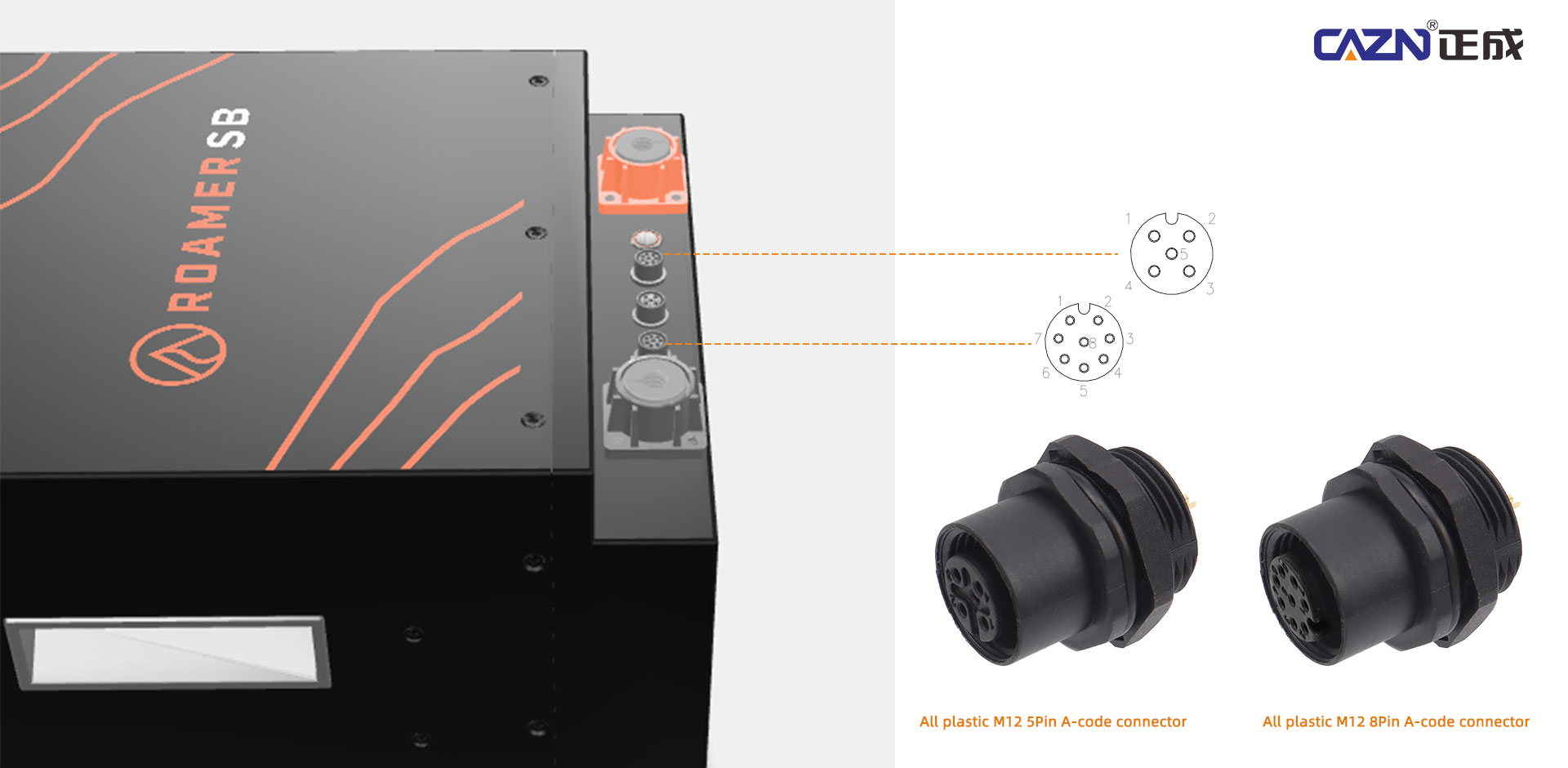
Different energy storage architectures require different numbers of signal and power connections. CAZN all-plastic M12 connectors are available in 5-pin, 6-pin, and 8-pin configurations to accommodate different system integration requirements.
5-Pin M12 Connectors: For Basic Low-Voltage Interconnection
Five-pin connectors are suitable for applications with relatively simple wiring requirements, such as combining auxiliary power supply with a limited number of status signals or supporting selected acquisition circuits on BMS slave control boards.
A typical configuration may include two power connections, two signal channels, and one reserved pin, depending on the system design.

6-Pin M12 Connectors: For More Flexible Signal Integration
Six-pin connectors provide additional wiring flexibility and can accommodate multiple temperature or voltage monitoring channels. They are also suitable for integrating communication, auxiliary power, and status signals within a single connector interface.
8-Pin M12 Connectors: For Higher-Density System Integration
Eight-pin connectors are suitable for more integrated applications requiring multiple functions within a compact connection interface. These may include CAN/RS-485 communication, auxiliary power, fault signals, and temperature control signals.
Integrating these connections into one interface helps reduce the number of individual cable connections inside battery cabinets and improves assembly efficiency.
For different energy storage applications, the configurations can be selected as follows:
Application | Typical M12 Connector Functions |
|---|---|
RV Energy Storage Battery PACK | Cell voltage and temperature acquisition, BMS slave-board communication, auxiliary power |
Portable and Mobile Energy Storage Cabinets | CAN/RS-485 communication, SOC/SOH data transmission, fan control, temperature monitoring |
Residential and Commercial & Industrial Energy Storage Modules | Cluster-level and module-level low-voltage data acquisition, internal auxiliary power connections |
The actual pin assignments should be determined according to the BMS architecture, electrical interface requirements, and connector datasheet.
Compared with conventional metal-housed connectors, all-plastic M12 connectors offer a significant weight advantage. For RV and portable energy storage systems, where overall equipment weight directly affects installation flexibility and mobility, lightweight connectors help reduce the weight of the connection system.
Plastic housings also provide good corrosion resistance and can accommodate humid and salt-laden environments. Combined with an IP67 protection design, these connectors can provide effective dust protection and resistance to temporary water immersion, making them suitable for installation inside energy storage cabinets, RV compartments, and outdoor enclosures with appropriate environmental protection.
However, an IP67 rating does not mean that connectors can be freely exposed to continuous immersion or high-pressure water jets. Actual suitability depends on the installation position, sealing structure, cable compatibility, and operating environment. Proper mating and installation are also essential to achieving the specified protection level.

Threaded Locking for Improved Connection Reliability Under Vibration
RV energy storage systems and mobile power equipment are continuously exposed to vibration and mechanical shock during transportation and operation. If conventional push-pull or insufficiently secured connectors become loose, intermittent electrical contact or accidental disconnection may occur.
M12 connectors feature a threaded locking mechanism. Once mated, the threaded coupling secures the connection and helps improve resistance to vibration and mechanical loosening.
For circuits that require continuous and stable operation, including BMS data acquisition, communication, and auxiliary power supply, reliable mechanical retention is an important foundation for electrical performance.
This makes threaded M12 connectors a practical option for low-voltage interconnections in mobile energy storage applications, where connection stability is particularly important.
It is important to emphasize that all-plastic M12 5/6/8-pin connectors are primarily designed for low-voltage signal transmission, communication, and auxiliary power circuits. They are not recommended as high-current power interfaces for the battery's main circuit.
The main power circuits in energy storage systems typically operate at higher voltages and carry substantially larger currents. These applications require dedicated high-current energy storage connectors, Manual Service Disconnects (MSDs), busbars, or other high-current power connection solutions.
The key advantages of M12 connectors lie in their suitability for low-current, multi-signal connections, environmental protection, and convenient installation—not high-current power transmission.
Clearly defining these application boundaries allows system designers to make more appropriate component selections, maximize product performance, and maintain electrical safety throughout the battery system.
Although all-plastic M12 5/6/8-pin connectors may not be the most visible components in an energy storage system, they play an important role in maintaining the reliability of BMS data acquisition, communication, and auxiliary power circuits.
Their lightweight plastic housings help reduce overall system weight. IP67 protection improves environmental adaptability. Multi-pin integration simplifies cable harness layouts, while threaded locking enhances mechanical stability under vibration.
For companies developing RV energy storage, portable power systems, and residential lithium battery solutions, selecting a low-voltage connector with clearly defined applications, reliable performance, and flexible configurations can make a meaningful difference. It helps create more compact wiring architectures while improving manufacturing efficiency, maintenance convenience, and future system expandability.
5-Pin: Suitable for BMS data acquisition cables and combined auxiliary power and communication circuits. A possible configuration includes two power connections, two signal channels, and one reserved pin.
6-Pin: Suitable for multiple temperature and voltage acquisition channels, or integrated communication, auxiliary power, and status signal connections.
8-Pin: Suitable for centralized integration of CAN/RS-485 communication, multiple sampling channels, auxiliary power, and fault signals, offering greater wiring integration.
Lightweight Design: Lighter than metal-housed alternatives, making them suitable for weight-sensitive RV and mobile energy storage equipment.
Cost Efficiency: A practical option for large-scale deployment in low-voltage monitoring, data acquisition, and auxiliary power circuits.
IP67 Protection: Provides protection against dust and temporary water immersion when properly mated, supporting demanding installation environments.
Corrosion Resistance: Plastic housings offer good resistance to corrosion in humid and salt-laden environments, making them suitable for outdoor and coastal RV applications.
All-plastic M12 5/6/8-pin connectors from CAZN are designed for low-voltage interconnection in RV lithium battery energy storage systems, providing practical connection solutions for BMS data acquisition, communication, and auxiliary power supply.
For product datasheets, pin assignment recommendations, or customized connector selection support, contact CAZN to discuss your energy storage application requirements.
Privacy Policy