Jan 29, 2026
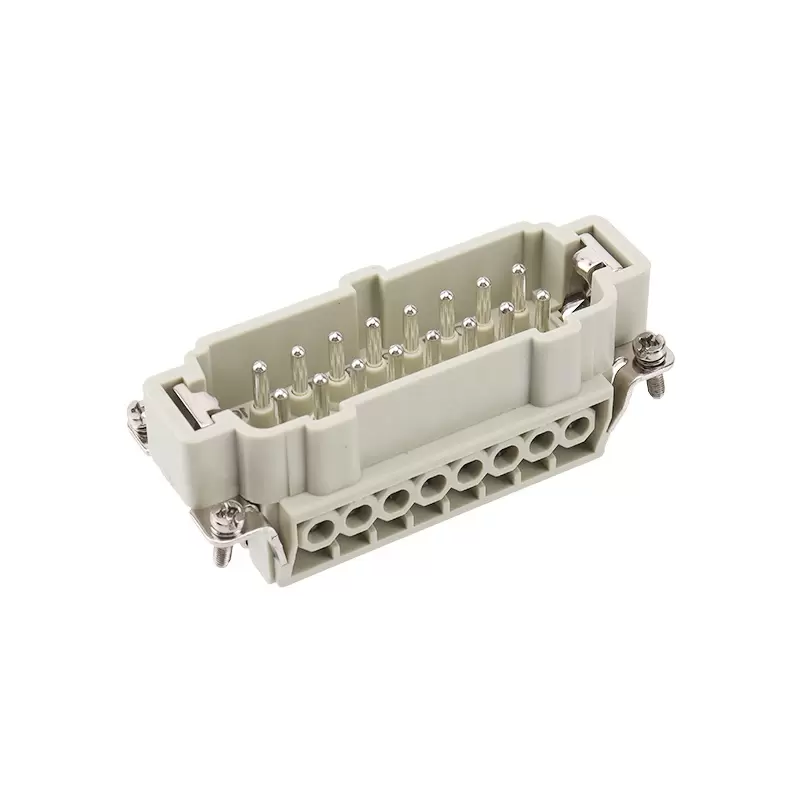
HE-016 Screw Connection HE-06-M: Reliable Termination for High-Density Industrial Connectors
Driven by the rapid growth of the electric vehicle and energy storage industries, lithium-ion and sodium-ion battery manufacturing is entering the terawatt-hour (TWh) era. From cell sorting, module loading, and laser welding of battery tabs to BMS harness installation and end-of-line (EOL) charge-discharge testing of complete battery PACKs, highly automated, takt-driven assembly lines place demanding requirements on industrial equipment, including industrial robots, precision laser welding machines, high-speed machine vision inspection systems, automated guided vehicles (AGVs), and testing workstations.
Modern power battery PACK production lines often target cycle times of 30–60 seconds. In high-throughput manufacturing environments characterized by strong electromagnetic interference (EMI) and continuous high-speed operation, industrial connectors and cables must withstand considerable mechanical and electrical stress.
High-frequency flexing and torsion in drag chains and robotic joints
During the rapid, repetitive movements of six-axis industrial robots used for battery cell handling and welding, cables installed in drag chains and robot arms must withstand millions of bending, twisting, and tensile cycles. Ordinary cables may develop conductor fatigue and breakage, shielding-layer fractures that compromise electromagnetic protection, or cracked outer jackets. These failures can trigger unexpected production line stoppages.
Severe EMI from laser welding and high-power servo drives
Battery PACK production lines frequently use kilowatt-class fiber lasers for copper and aluminum battery-tab welding, while multiple high-power servo motors accelerate and decelerate at high frequency. Electromagnetic pulses and harmonic interference can couple into industrial bus cables and machine vision signal lines, potentially causing Industrial Ethernet packet loss, image artifacts from industrial cameras, or inaccurate measurement data.
High-frequency mating wear in EOL testing stations
During electrical performance and insulation withstand-voltage testing, quick-connect test interfaces may be mated and unmated hundreds or even thousands of times per shift. Ordinary industrial terminals with limited mating durability can experience contact-plating wear and increased contact resistance, potentially producing false test failures and inaccurate battery PACK acceptance results.
Metallic spatter and welding fume contamination
Fine metallic particles generated during laser welding, together with airflow and pressure differences created by dust extraction systems, place stringent demands on connector sealing, dust protection, and the thermal resistance of insulating housings.

To support demanding equipment availability targets, such as an overall equipment effectiveness (OEE) target of 90% or higher, Shenzhen CAZN Electrical Co., Ltd. (CAZN) provides connector and cable solutions designed for high-flexibility applications, EMI resistance, and extended mating life.
Ultra-fine stranded oxygen-free copper conductors
Each conductor can be constructed from finely stranded, high-purity oxygen-free copper wires with individual wire diameters of approximately 0.05–0.08 mm. Combined with low-friction modified TPE or PP conductor insulation, this construction can reduce internal mechanical stress and improve flexibility under repeated movement.
Abrasion-resistant PUR outer jackets
High-mechanical-strength polyurethane (PUR) jackets offer resistance to mineral oils, coolants, and cutting fluids, depending on the material formulation. For demanding drag chain applications, the cable design can target continuous flexing endurance of at least 10 million cycles, subject to the specified test conditions and validation results.
Integrated injection-molded strain relief
The connector tail and PUR cable jacket can be integrated through secondary vertical injection molding to create a continuous interface with graduated strain relief. This helps reduce stress concentrations at the cable exit and minimizes the risk of damage caused by sharp bending near the connector.
360-degree shielded construction
M12 X-coded connectors use an internal metallic cross-divider to physically separate the four twisted pairs. This structure helps control near-end crosstalk (NEXT) and far-end crosstalk (FEXT), supporting Cat 6A-class cabling and data transmission rates of up to 10 Gbps when the complete channel meets the relevant requirements.
Robust zinc-alloy die-cast housings
Zinc-alloy die-cast housings can provide mechanical protection and contribute to electromagnetic compatibility (EMC). Shielding effectiveness depends on the complete connector and cable assembly, including shield termination, mating interfaces, and installation. Performance targets such as attenuation exceeding 50 dB at 500 MHz should be verified through product-specific test reports rather than assumed for every model.
These design features help protect machine vision and industrial communication links against interference from high-power laser equipment and high-frequency inverters.
Thick hard-gold plating
Contact pins can use spring-grade beryllium copper or phosphor bronze substrates, with a nickel underlayer and hard-gold plating approximately 30–50 microinches thick (0.76–1.27 μm), depending on the contact specification. A properly engineered contact system can target 5,000 or more mating cycles while maintaining stable contact resistance under defined test conditions.
Floating blind-mate mechanisms
Test interfaces can incorporate a floating, self-aligning mechanism with axial compensation of ±2 mm and radial compensation of ±1.5 mm. This helps accommodate minor positioning errors in automated handling equipment and fixtures, reducing the risk of bent contacts and mechanical damage during repeated mating.

Key Performance Indicator | Standard Commercial Cables | General Industrial Cables | CAZN High-Flex Shielded Cable Assemblies for Battery Equipment |
|---|---|---|---|
Drag chain flex life | Typically below 500,000 cycles in lower-grade designs | Approximately 2–5 million cycles for some designs | Target of 10 million cycles or more for validated configurations |
Gigabit machine vision EMI protection | May experience interference-related packet loss or image disruption | Single-layer aluminum foil shielding may be insufficient in demanding high-frequency environments | Dual shielding using aluminum foil and an 85% tinned-copper braid, with 360-degree shield termination |
Oil and spatter resistance | PVC jackets may deteriorate when exposed to incompatible oils or chemicals | Standard PUR provides application-dependent resistance | Specialized flame-retardant, abrasion-resistant, oil-resistant PUR formulations for suitable environments |
Connector mating durability | Varies by product; lower-grade terminals may have limited durability | Often approximately 200–500 cycles for selected products | Configurations targeting 500–5,000 or more cycles, depending on contact design and plating |
Ingress protection | Some products provide only IP20 protection | Commonly available in IP65–IP67 configurations | IP67/IP68 options available where specified and validated |
Note: These figures are indicative design targets and comparison ranges, not universal industry ratings. Actual performance depends on cable construction, connector design, test methods, installation conditions, and the relevant product datasheet. IP68 performance must be evaluated against the manufacturer's specified immersion conditions.
Operating conditions
High-resolution industrial cameras, including systems from manufacturers such as Basler, Cognex, and Daheng, move along servo-driven X, Y, and Z axes to inspect battery-tab dimensions, weld defects, and blue-film surface conditions. Rapid camera movement and high-speed image acquisition require stable data transmission, especially when multiple inspection stations operate simultaneously.
Recommended solution
CAZN M12 X-coded-to-RJ45 high-flex Ethernet cable assemblies designed for demanding machine vision applications.
Expected benefits
When the complete cabling channel supports the required transmission rate and EMI performance, a properly designed assembly can reduce communication errors and support reliable high-speed image acquisition. Cable flex life and connector shielding should be validated under the actual motion profile and installation conditions.
Operating conditions
Laser welding heads may integrate laser positioning sensors, protective gas systems, and coaxial temperature probes close to the welding zone. These components face mechanical movement, localized heat, metallic spatter, and electromagnetic interference from associated equipment.
Recommended solution
CAZN M8 threaded-locking, all-metal, shielded cable assemblies designed for demanding industrial sensor connections.
Expected benefits
The compact form factor can help reduce installation space and cable weight, while the metallic housing can provide mechanical protection against suitable environmental hazards. Proper shielding and cable routing help maintain stable temperature and distance-measurement signals between the sensors and laser control system.
Actual resistance to welding spatter and elevated temperatures depends on the connector materials, cable jacket, mounting position, and exposure duration. Additional protection or relocation may be necessary near direct spatter exposure.
Operating conditions
Automated fixtures connect to high-voltage battery outputs and low-voltage BMS control interfaces to perform insulation resistance and withstand-voltage tests, open-circuit voltage measurements, AC internal resistance (ACIR) measurements, and fast-charging handshake verification.
These stations require reliable contact performance, repeatable positioning, and clear separation between high-voltage and low-voltage circuits.
Recommended solution
CAZN custom high-mating-cycle test connectors and application-specific fixture cable assemblies.
Expected benefits
Wear-resistant gold-plated contacts combined with a floating housing design can help extend fixture maintenance intervals and reduce connection-related test errors. The contact system should be selected according to the applicable voltage, current, insulation, and measurement requirements. High-voltage testing interfaces also require appropriate creepage and clearance distances, insulation design, interlocking where necessary, and protection against accidental contact.
For automation equipment manufacturers, delays in custom connector development and delivery can affect the commissioning and ramp-up of an entire production line. CAZN focuses on responsive customization and structured quality verification to address these challenges.
CAZN supports customized cable lengths, pin assignments, connector orientations, and directional 90-degree angled exits according to project requirements. CAD and SolidWorks-based structural design, together with in-house mold-making capabilities, can support the development of application-specific connector and cable assemblies.
For standard customization projects, prototype delivery may be achievable within 3–5 days, subject to design complexity, material availability, and sample approval requirements. Early technical alignment helps reduce rework and accelerates integration into automated equipment.
CAZN's testing capabilities include continuous drag chain flex testing, oscillating flex testing, vector network analyzer (VNA) measurements, and micro-ohm resistance measurements. These tests can help evaluate cable mechanical endurance, high-frequency transmission characteristics, and contact resistance.
For battery equipment applications, test criteria should be defined around the actual operating conditions. Relevant parameters may include bending radius, travel speed, acceleration, torsion angle, cable routing, mating frequency, temperature, shielding termination, and transmission bandwidth. Test reports should identify the tested product configuration, sample size, method, and acceptance criteria so that the results can be applied appropriately to production requirements.

Intelligent manufacturing equipment is essential to the production of high-quality power batteries, and industrial connectors and cables form a critical part of the infrastructure that keeps these systems operating reliably. In automated battery PACK production lines, high-frequency cable flexing, electromagnetic interference, repeated mating, and contamination from welding operations can all affect equipment availability and production quality.
CAZN provides industrial connector and cable solutions for demanding automation applications, including high-flex PUR cable assemblies, shielded M12 X-coded Ethernet connections, compact M8 sensor interfaces, and customized high-cycle test connectors. Through application-specific design, prototype development, and mechanical and electrical validation, CAZN helps equipment manufacturers address connection reliability and maintenance challenges.
By matching connector selection, cable construction, shielding, mating durability, and environmental protection to the actual operating conditions, battery equipment integrators can build more reliable production systems and support stable, high-quality manufacturing at scale.
Privacy Policy