Sep 10, 2026
CAZN M8 D-Code 4-Pin Shielded Connector for EtherCAT Industrial Communication
From autonomous navigation and crop localization to visual recognition, AI-based maturity detection, robotic-arm positioning, flexible gripping, damage-free collection, and autonomous transport, fruit and vegetable harvesting robots require a complete closed-loop operating system. These machines must operate continuously in open orchards and humid greenhouses, where dust, dew, fruit juice, vibration, and uneven terrain create demanding conditions for electrical connections. CAZN industrial circular connectors provide highly reliable power and signal interconnection solutions across the entire harvesting robot system, helping ensure stable and continuous operation in demanding agricultural environments.

An orchard harvesting robot relies on coordinated operation among multiple subsystems, and every stage depends on reliable connectors and electrical interfaces.
The chassis navigation and positioning unit needs to receive real-time signals from GNSS, LiDAR, IMU, encoders, and obstacle-avoidance sensors. EtherCAT is used for real-time motion control of servo steering wheels. CAZN M12 circular connectors cover multiple coding configurations, including A, D, X, and L coding. A-coded connectors are used for proximity switches and analog or digital sensor signals; D-coded connectors support EtherCAT industrial Ethernet communications; L-coded connectors handle high-current power for chassis servo systems. M8 miniature circular connectors can be used for compact infrared and photoelectric obstacle-avoidance sensors. Threaded locking and IP67 protection help maintain secure connections under mud, water splashes, and continuous vibration.
Chassis Navigation and Positioning Subsystem
Components: Steering wheels / drive motors, wheel encoders, LiDAR, IMU, GNSS positioning, obstacle-avoidance sensors, chassis controller
M12 circular connectors — primary interface
M12 A-coded: Proximity switches, IMU, encoders, and various digital/analog sensor signals
M12 D/X-coded: Industrial Ethernet such as EtherCAT and PROFINET for real-time chassis servo communications
M12 L-coded: High-current power supply for chassis servo motors
M8 circular connectors: Compact photoelectric and infrared obstacle-avoidance sensors, with a small footprint and IP67 protection
Electrical communication interfaces: EtherCAT, Modbus-RTU, CAN bus (CANopen), and emergency-stop safety circuits
Power interfaces: 24 V DC power circuits; high-power applications can use power-rated M12 or M16 connectors, while charging ports commonly use high-current waterproof aviation connectors

Vision sensing and AI recognition function as the “eyes and brain” of a harvesting robot. RGB-D depth cameras, end-of-arm cameras, and auxiliary lighting continuously capture orchard images for fruit recognition and AI-based maturity assessment. CAZN M12 X-coded connectors support GigE Vision applications while enabling Gigabit image transmission and PoE power delivery. Their 360° shielding helps suppress electromagnetic interference generated by chassis motors, maintaining stable image transmission and reducing the risk of fruit-recognition errors caused by signal distortion.
Vision Sensing Subsystem
Function: Crop visual recognition and AI-based maturity detection
Components: RGB cameras, RGB-D depth cameras, global-view / end-of-arm cameras, image acquisition cards, and lighting
Connectors
M12 X-coded: GigE industrial cameras using the GigE Vision protocol for image transmission and PoE power delivery
Waterproof USB 3.0 connectors: Board-mount or cable-type interfaces for compact depth cameras
M8: Trigger signals for auxiliary lighting
Electrical interfaces: GigE Vision, USB 3.0, PoE Ethernet, and camera trigger I/O signals

During robotic-arm movement, servo joints, force sensors, and encoders form a closed-loop motion-control system that requires low-latency communication and reliable power delivery. CAZN M12 D-coded EtherCAT connectors support synchronized multi-axis control, while A-coded connectors collect joint force-feedback signals. M16 power connectors provide high-current power for servo systems. Dual-channel safety interfaces can be used for emergency-stop circuits to support equipment safety requirements and maintain precise robotic-arm operation.
Robotic Arm Motion Control
Function: Robotic-arm positioning and approach
Components: Six-axis collaborative robotic arm, servo motors, joint encoders, force sensors
M12 D-coded EtherCAT: Real-time servo bus communication
M12 A-coded: Joint encoder and force-control sensor feedback
High-current M12/M16 power connectors: Servo motor power supply
Safety circuit: Dual-channel emergency-stop signal interface through a safety relay circuit
Communication protocol: EtherCAT is widely used for low-latency closed-loop communication between the robotic arm and main controller

The end effector directly interacts with the fruit and is one of the most demanding parts of the robot. Flexible grippers, cutting mechanisms, pressure sensors, and miniature end-of-arm cameras must operate within limited space while being exposed to dew, fruit juice, and dust. CAZN M5 miniature circular connectors and M8 compact connectors provide a small form factor suitable for confined end-effector spaces. Board-mount SMD solutions are also available for compact layouts. Electrical-pneumatic hybrid connectors can integrate electrical signal transmission and pneumatic tubing into one connection, supporting flexible gripping and cutting operations while enabling stable feedback for damage-free harvesting.
End-of-Arm Tooling
Function: Flexible gripping / cutting, damage-free harvesting, and fruit collection
Components: Flexible grippers, pneumatic cutting blades, suction harvesting heads, pressure sensors, miniature end-of-arm cameras
The end effector is highly exposed to dew, fruit juice, and dust and therefore requires a high level of protection.
M8 connectors: Miniature end-effector sensors, pressure film sensors, and small I/O trigger signals
M12 A-coded: Gripper servo and pneumatic solenoid-valve signals
Pneumatic integration: Electrical-pneumatic hybrid connectors combining electrical connections and pneumatic tubing
Interfaces: Digital I/O and analog pressure-feedback signals; some compact end effectors can use M5 miniature circular connectors for space-constrained, board-mount applications
Transfer and Collection System
The conveyor belts, lifting mechanisms, fruit-bin positioning sensors, and unloading actuators used for fruit transfer and collection can use CAZN M8/M12 A-coded connectors for photoelectric positioning signals and actuator control. These interfaces support automated fruit transfer and collection. The main controller and lithium battery BMS power-management system can use CAZN M23 high-current power connectors for the main power input, together with waterproof USB and Ethernet interfaces for field commissioning and maintenance.
Transfer and Collection System
Components: Conveyor belts, lifting mechanisms, fruit-bin positioning sensors, unloading actuators
M8/M12 A-coded: Photoelectric positioning sensors and proximity switches
M12 power connectors: Conveyor motor power supply
Control: Modbus or CAN bus for mechanism control
Main Controller and Power Management
For long-duration continuous operation, agricultural robots require stable connections across the main controller, battery management system, power distribution board, and DC-DC modules.
Communication interfaces include EtherCAT, CAN, and RS485 (Modbus-RTU).
Power connectors
Lithium battery BMS: High-current waterproof aviation connectors such as M23
Internal low-voltage branches: M12 L-coded connectors for 24 V power distribution
Commissioning interfaces: Waterproof USB and Ethernet connectors for field maintenance and troubleshooting
Typical Harvesting Robot Applications
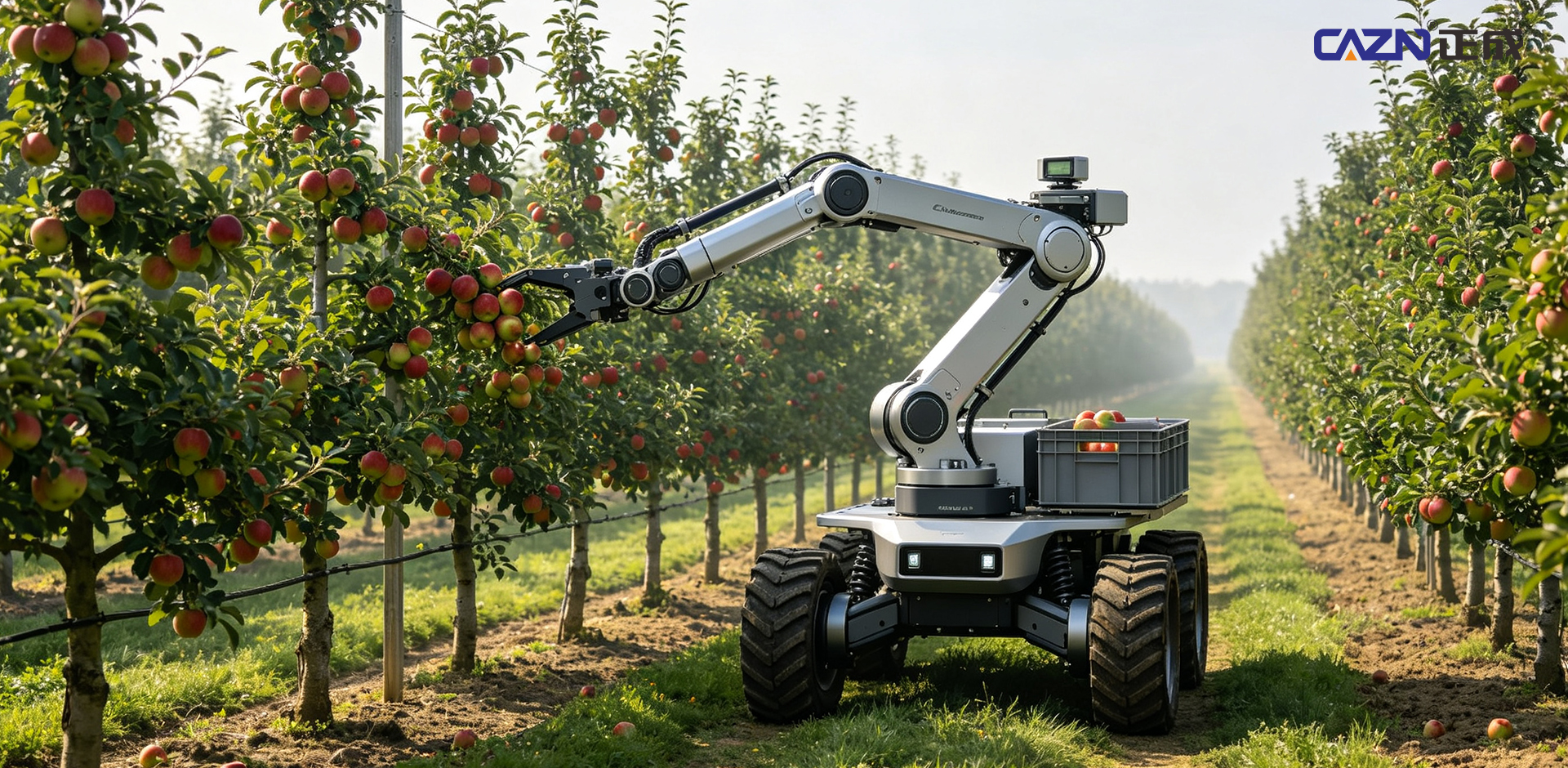
Case 1: Apple Harvesting “Twin Robots” in Huangling, Shaanxi
Application: A 500-mu standardized dwarf apple orchard using harvesting robots, transport robots, and inspection robots for coordinated operations and a complete closed-loop workflow.
Operating process: Autonomous chassis navigation → LiDAR and vision-based apple maturity recognition → multi-axis robotic-arm positioning → flexible gripping and harvesting → automatic fruit-bin collection and transportation.
Equipment challenges: Open-air orchard conditions expose equipment to mud, water, vibration, and strong sunlight. EtherCAT communications, industrial-camera image transmission, and servo power lines can be affected by electromagnetic interference from motors. Multiple subsystems, including the chassis, robotic arms, and end effectors, also require numerous high-protection circular connectors.
Interconnection requirements: M12 D-coded EtherCAT communication connectors, M12 X-coded GigE vision connectors, M12 L-coded servo power connectors, and M8 connectors for end-effector sensors.
Orchard vibration, dew, dust, and water are unavoidable. CAZN M12 circular connectors combine IP67 protection and 360° shielding to support stable communications in multi-robot applications, helping reduce communication interruptions and recognition errors during continuous apple-harvesting operations.
Case 2: Double-Arm Winter Jujube Harvesting Robot in Dali, Shaanxi
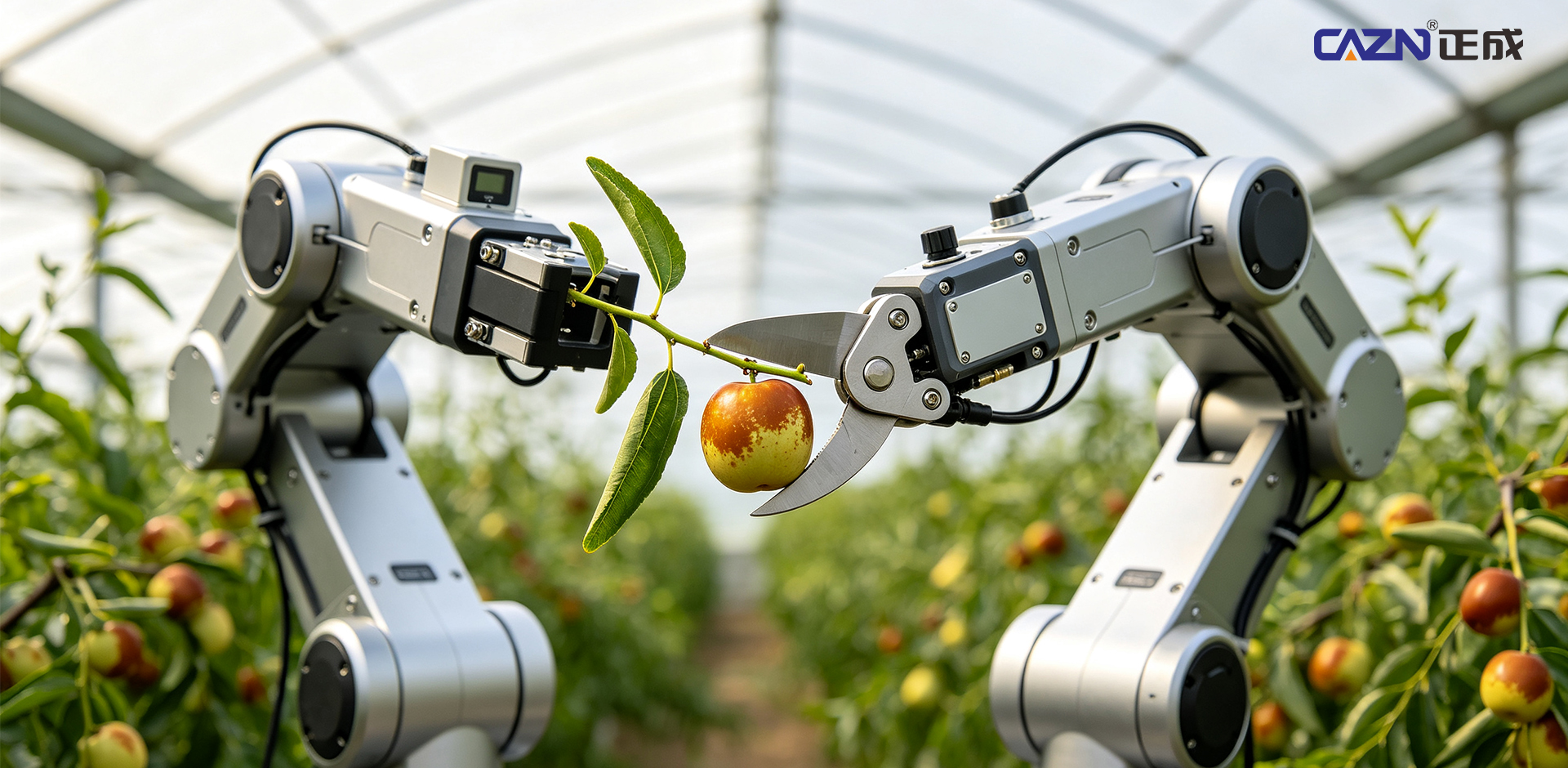
Application: Winter jujube cultivation in greenhouse rows with limited spacing. Two robotic arms operate in parallel for harvesting and grading, supporting multi-robot operation.
Operating process: Four-wheel steering chassis moves laterally through narrow greenhouse rows → AI vision identifies winter jujube maturity → dual robotic arms harvest simultaneously → flexible grippers pick fruit while grading is performed → automatic collection.
Equipment challenges: High humidity and fruit juice splashes are common in greenhouses. End-effectors have extremely limited installation space and require numerous miniature pressure sensors and end-of-arm cameras.
Interconnection requirements: M5 miniature circular connectors and M8 connectors for end-effector sensors, with M12 A-coded connectors for pressure-feedback signals.
In confined greenhouse end-effectors, CAZN M5 and M8 miniature circular connectors provide compact solutions and support SMD board-mount configurations. Their threaded locking design and protection against humidity and fruit juice help maintain stable sensor signals for flexible, damage-free harvesting.
Case 3: Smart Kiwifruit Farm in Fenghuang, Hunan
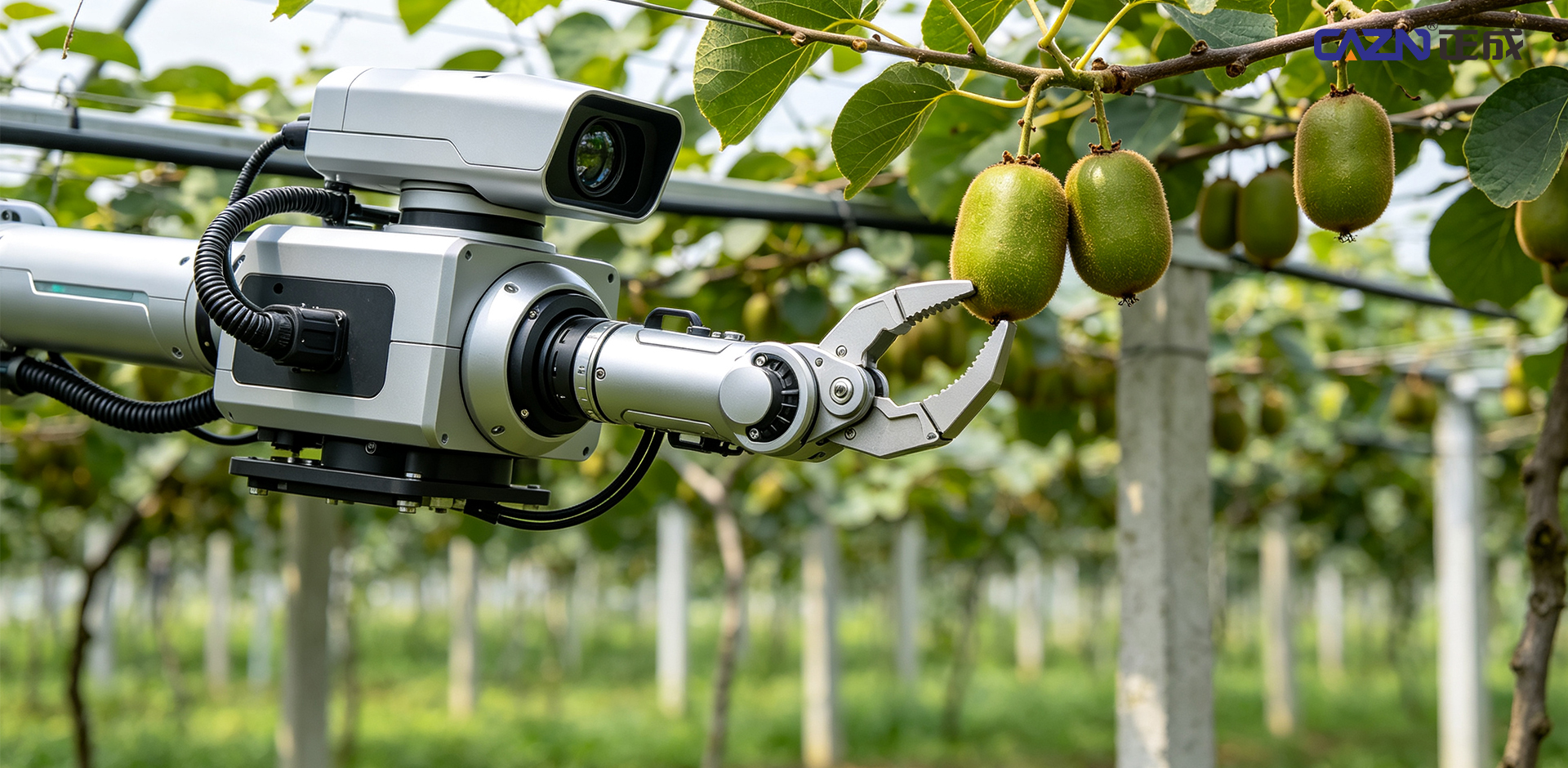
Application: More than 20,000 mu of trellis-grown kiwifruit orchards, with an unmanned farming system covering inspection, harvesting, transportation, and fruit sorting.
Operating process: An autonomous navigation chassis moves beneath the trellis → vision systems identify fruit → multi-degree-of-freedom robotic arms cut fruit stems → harvested fruit is automatically transferred to collection bins → transport robots deliver the fruit to the sorting facility.
Equipment challenges: Outdoor orchards remain humid for long periods. Vines and foliage can obstruct equipment, while continuous vibration can affect bus communications and sensor signals.
Interconnection requirements: M12 A/D-coded connectors and M16 connectors for power circuits.
Case 4: Wine Grape Harvesting Prototype in Xinjiang
Application: A tracked harvesting platform operates in open-field trellis vineyards. Robotic arms cut grape stems, while an air-suction system transfers grapes into collection bins.
Operating challenges: High levels of field dust and large temperature differences require reliable chassis navigation and coordinated harvesting-system control. Communication links must remain stable under demanding outdoor conditions.

Case 5: Double-Arm Tomato Harvesting Robot at Nanjing Agricultural University
Application: A double-arm harvesting robot operates in a multi-span greenhouse for tomato cultivation. Vacuum suction end effectors are used for harvesting, with a reported single-fruit harvesting time of 5.2 seconds and an overall rate of approximately 16–18 tomatoes per minute.
Equipment challenges: High greenhouse humidity, auxiliary lighting, and depth cameras create complex electrical conditions. PoE image transmission can be affected by electromagnetic interference from servo motors.
Interconnection requirements: M12 X-coded GigE vision connectors and M8 connectors for lighting trigger signals.

Case 1: FFRobotics Multi-Arm Apple Harvesting Robot, Israel
Application: Standardized V-shaped dwarf apple orchards in Europe and North America, with 12 sets of robotic arms operating in parallel for large-scale commercial fruit harvesting.
Technical characteristics: Multiple robotic arms operate through synchronized EtherCAT communication, with numerous servo motors and end-effector force sensors supporting long-duration outdoor operation.
Interconnection challenge: Multiple arms operating simultaneously can increase electromagnetic interference, creating requirements for highly shielded and vibration-resistant connectors.
Case 2: Robotics Plus Kiwifruit Harvesting Robot, New Zealand
Application: Trellis-grown kiwifruit orchards, where four robotic arms work in parallel to identify mature kiwifruit, perform flexible gripping, and automatically collect and transport harvested fruit.
Technical characteristics: Distributed multi-arm control requires numerous sensors across robotic-arm joints and end effectors.
Case 3: Agrobot Strawberry Harvesting Robot, Spain
Application: Elevated greenhouse strawberry cultivation with up to 24 robotic arms operating in parallel. Flexible harvesting is used to reduce damage to the soft strawberry surface.
Interconnection challenge: Extremely limited end-effector space and a large number of miniature pressure sensors and cameras create demand for compact M8/M5 connectors.
Case 4: Abundant Robotics Vacuum Apple Harvesting Robot, United States
Application: Dwarf apple orchards using a vacuum-based harvesting end effector. Commercial orchard field trials have involved mobile chassis systems working together with vacuum harvesting heads.
Technical characteristics: The integrated mobile platform and vacuum harvesting system rely on numerous servo and vision components, creating demanding requirements for communication stability.

From winter jujube harvesting in domestic greenhouses and open-field apple orchards to kiwifruit operations and standardized overseas apple and strawberry orchards, the commercialization of harvesting robots depends on reliable interconnection across chassis navigation, vision sensing, multi-axis robotic arms, and flexible end-effectors. High humidity, dust, vibration, fruit-juice exposure, electromagnetic interference from motors, and other agricultural conditions place demanding requirements on connector protection, shielding, environmental resistance, and miniaturization.
CAZN offers a complete range of M5, M8, M12, M16, and M23 industrial circular connectors covering EtherCAT industrial communication, GigE vision transmission, servo power delivery, and miniature end-effector sensor signals. This product portfolio provides a comprehensive interconnection solution for fruit and vegetable harvesting robots, supporting agricultural robotics manufacturers from prototype development and field testing through to large-scale commercial deployment.
Privacy Policy