Apr 29, 2026
How to Select a Mini UHF Connector: Performance Limits, Cable Matching, and Long-Term Reliability
With the widespread adoption of horizontal and tilted single-axis solar tracking systems, photovoltaic power plants are no longer static installations. Main beams rotate continuously, while cables undergo repeated bending and twisting over extended operating periods. Fretting corrosion, connector loosening, and intermittent bus communication failures have become common issues in tracking systems. When combined with BMS and PCS communication networks in supporting energy storage installations, incorrect connector selection can lead to an entire row of tracking units shutting down or communication interruptions across battery systems.

Solar tracking systems typically require two independent connection paths: motor power supply and signal communication. Selecting the correct M12 connector coding for each circuit is essential to prevent mismating and ensure reliable operation.
1.1 Power Circuit: Electric Linear Actuators
Electric linear actuators generally operate on 24V or 48V DC power. M12 A-coded 2-pin or 3-pin right-angle connectors are suitable for these low-voltage power connections, subject to the actual current and electrical ratings required by the application.
The right-angle design fits into the confined spaces inside tracking support structures and helps reduce cable bending stress. The threaded locking mechanism provides secure connections under wind-induced vibration, reducing the risk of connector loosening, intermittent contact, and electrical arcing.
1.2 Bus Communication: The Core of Tracking Control
Communication connections require careful selection according to the protocol and network architecture.
- CANopen / NMEA 2000: M12 A-coded 5-pin shielded connectors are commonly used for daisy-chain connections involving tilt sensors, limit switches, and local controllers. T-type connectors support convenient bus network expansion. Full shielding helps reduce electromagnetic interference from inverters and other high-power equipment, improving the reliability of tracking angle data transmission.
- 100 Mbps EtherCAT Closed-Loop Control: M12 D-coded 4-pin connectors are used for compatible industrial Ethernet connections, including absolute encoder feedback applications. They support high-speed communication for motor control and position feedback, helping tracking systems achieve precise positioning. A tracking accuracy target of ±0.1° must also be supported by the complete mechanical and control system.
- Gigabit Centralized Array Control: M12 X-coded 8-pin connectors are suitable for next-generation intelligent photovoltaic installations requiring centralized networking across multiple tracking units. Gigabit Ethernet connectivity supports high-volume data transmission and remote monitoring across large solar arrays.
Critical Compatibility Rule: A-coded, D-coded, and X-coded M12 connectors feature different physical keying structures and cannot be directly mated with one another. This mechanical coding provides foolproof protection against incorrect connections, helping prevent wiring errors at the installation stage.
Energy storage systems operating alongside photovoltaic tracking installations require reliable connections for both high-voltage power transmission and low-voltage communication.
High-Voltage DC Connections Between Battery Clusters
High-voltage single-pole energy storage connectors with orange housings are commonly used for DC connections between battery clusters. Integrating a High Voltage Interlock Loop (HVIL) helps monitor connection status and supports high-voltage safety management.
For systems operating at up to 1500V DC, connectors must be selected according to rated current, contact resistance, temperature rise, insulation performance, and applicable safety requirements. Low contact resistance and effective thermal management are particularly important for high-current battery connections.
BMS and EMS Communication
M12 A-coded connectors can be used for CAN bus communication between battery management systems, energy management systems, tracking controllers, and compatible inverter control equipment. This enables coordinated data exchange between photovoltaic generation and energy storage systems, supporting integrated monitoring and control.
The communication protocol, pin assignment, termination, shielding, and network topology must be verified before implementation to ensure compatibility across different devices.
Solar tracking systems operate under continuous mechanical movement and changing environmental conditions. Connector selection must therefore consider more than nominal electrical specifications.
Resistance to Fretting Wear
Repeated movement and vibration can cause microscopic relative motion between electrical contacts, gradually increasing contact resistance and potentially leading to intermittent signal transmission. Gold-plated contacts help improve contact stability and corrosion resistance, while threaded locking mechanisms reduce the risk of loosening under vibration.
For tracking applications, connector durability should be evaluated against the expected movement cycles, contact plating specifications, and actual operating conditions.
Environmental Protection and Weather Resistance
Outdoor photovoltaic installations expose connectors to rain, dust, ultraviolet radiation, temperature fluctuations, and corrosive environments. Recommended selection requirements include:
IP67 protection against dust ingress and temporary water immersion when correctly assembled with compatible mating components.
Operating temperature range of -40°C to +80°C, subject to the connector manufacturer's specifications.
UV-resistant housing and cable materials.
Salt spray corrosion resistance, with enhanced protection for coastal and tidal-flat photovoltaic installations.
Actual protection performance depends on the complete connector assembly, including mating interfaces, cable glands, seals, and installation quality.
Cable Flexibility and Mechanical Stress Relief
Connector reliability also depends on cable management. High-flexibility drag-chain cables should be selected for applications involving continuous movement. Sufficient cable length and movement allowance must be provided to accommodate the full tracking angle without excessive bending or tension.
Connectors should never be used as mechanical load-bearing points for cable twisting, pulling, or repeated bending. Proper strain relief and cable routing help prevent premature conductor fatigue and connection failure.
For photovoltaic tracking and energy storage applications, the basic selection principle is simple: one coding type for its designated connection purpose.
A-coded: Sensors, switches, and CAN bus communication.
D-coded: 100 Mbps industrial Ethernet and compatible EtherCAT connections.
X-coded: Gigabit Ethernet and centralized array networking.
B-coded: PROFIBUS communication, primarily retained for maintenance and replacement of legacy equipment rather than new installations.
Different coding structures provide physical mismating protection, but correct selection must also consider electrical ratings, communication protocols, pin configurations, and device compatibility.

5. M12 Coding Selection Table for Solar Tracking Systems
The following selection guide covers common connection requirements for horizontal and tilted single-axis solar tracking structures.
M12 Coding / Pin Count | Application | Communication / Power Type | Key Selection Requirements | Connector Configuration |
|---|---|---|---|---|
A-coded 5-pin | Tilt sensors, limit switches, CANopen / NMEA 2000 bus, T-type daisy-chain networks | CANopen / NMEA 2000 | Full shielding, gold-plated contacts, IP67, target bending endurance of 2,000 cycles or more | Straight and 90° right-angle |
A-coded 2/3-pin | Electric linear actuators and drive motors | 24V / 48V DC power | Vibration-resistant threaded locking and secure contact retention | Right-angle preferred |
D-coded 4-pin | 100 Mbps EtherCAT, compatible absolute encoder feedback connections | 100 Mbps Industrial Ethernet | Dual shielding and high-flexibility drag-chain cables | Mainly straight |
X-coded 8-pin | Gigabit EtherCAT, centralized array control, remote monitoring | Gigabit Industrial Ethernet | CAT6A-compatible double shielding and EMI resistance | Straight |
Note: Pin configurations, communication compatibility, and cycle-life requirements should be confirmed against the specifications of the connected equipment and the selected connector assembly.
With extensive experience in industrial connector manufacturing, CAZN provides M12 connector solutions for photovoltaic tracking systems, energy storage installations, and other demanding industrial applications.
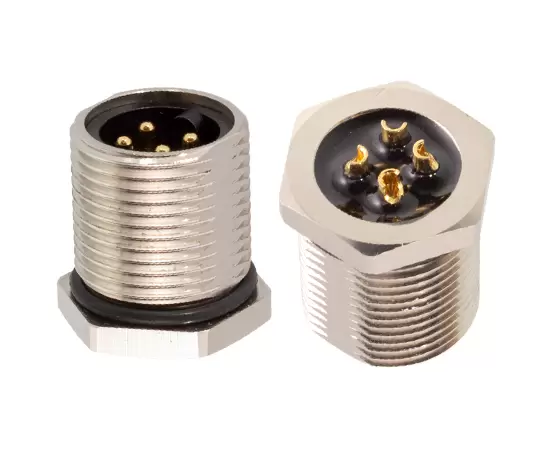
CAZN offers M12 connectors across multiple coding types, including A-coded, D-coded, X-coded, and B-coded configurations. Straight and right-angle designs, shielded and unshielded versions, and customized cable assemblies are available to accommodate different installation environments and connection requirements.
For solar tracking applications, the product range supports different power and communication interfaces, helping address challenges associated with outdoor exposure, continuous mechanical movement, vibration, and electromagnetic interference. Customized wiring harnesses can also simplify installation and improve connection consistency across large photovoltaic arrays.
From electric actuator power connections and sensor communication to industrial Ethernet networking and energy storage system integration, CAZN provides a coordinated approach to industrial connectivity.
One code, one purpose. Correct coding, reliable connections. By matching connector coding, electrical specifications, and mechanical requirements to each application, photovoltaic and energy storage operators can reduce installation errors, improve communication reliability, and minimize maintenance risks throughout the service life of their systems.
Privacy Policy